Key Takeaways
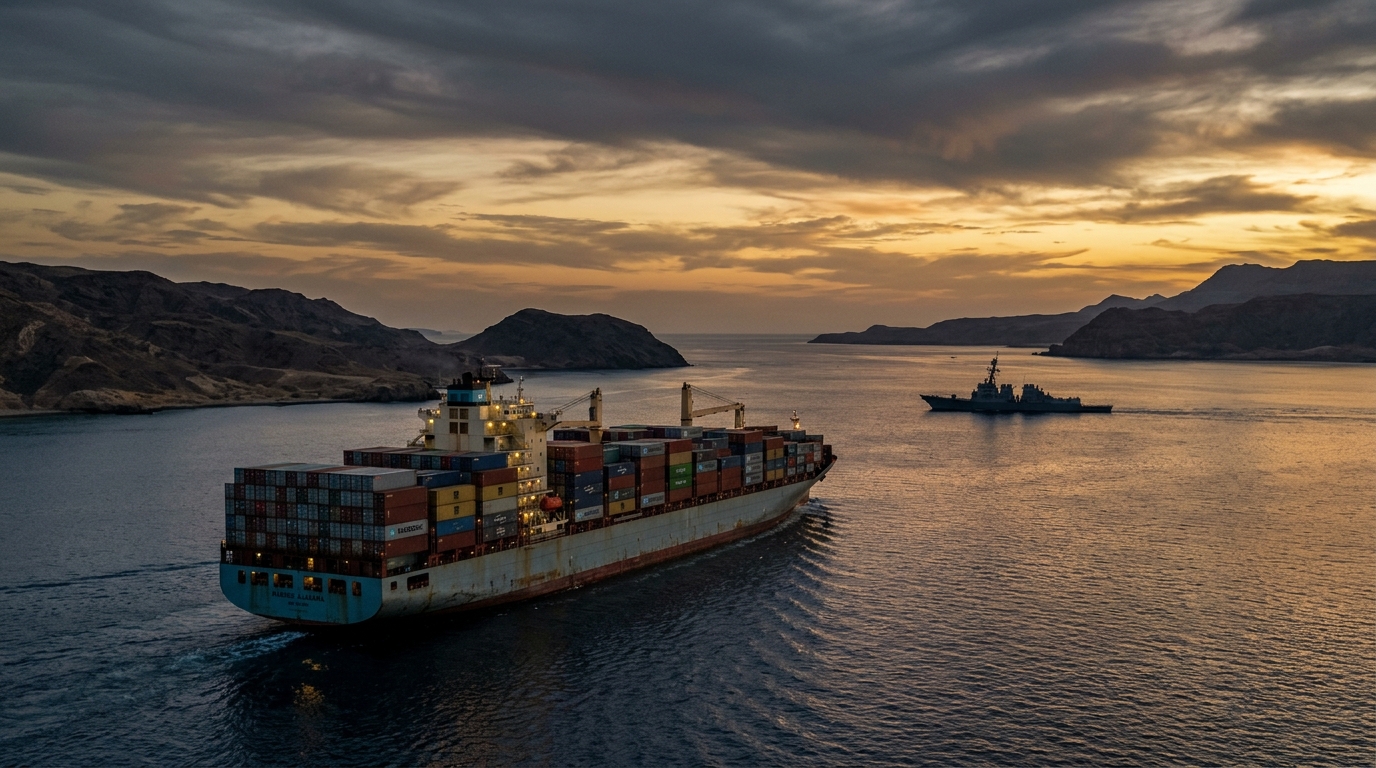
- The Bab el-Mandeb strait and Suez Canal corridor normally carry approximately 12% of global trade and 30% of global container traffic, making the Red Sea one of the world's most sensitive strategic chokepoints.
- The deployment of low-cost anti-ship ballistic missiles, cruise missiles, and one-way attack drones by non-state actors created a severe cost-exchange asymmetry against multi-million-dollar naval surface-to-air interceptors.
- Major global shipping alliances rerouted container vessels around South Africa's Cape of Good Hope, adding 10 to 14 days to Asia-Europe transit times and drastically reducing Egyptian Suez Canal revenues.
Geopolitical anatomy of the Red Sea corridor
Since the opening of the Suez Canal in 1869, the Red Sea has functioned as the primary maritime artery linking the industrial centers of Europe and the Mediterranean basin with the manufacturing and energy hubs of East Asia, South Asia, and the Persian Gulf. At the southern entrance of this 2,250-kilometer waterway lies the Bab el-Mandeb ("Gate of Tears"), a narrow strait separating the southwestern tip of the Arabian Peninsula in Yemen from Djibouti and Eritrea on the Horn of Africa.1 At Perim Island (Mayyun), the navigable shipping lanes narrow to just two channels measuring roughly three kilometers and sixteen kilometers wide.
In standard peacetime conditions, approximately 12% to 15% of total global seaborne trade—and nearly 30% of global container volume—transits the Red Sea and the Suez Canal each year. This includes roughly 7 to 9 million barrels per day of crude oil and refined petroleum products, alongside 8% of global liquefied natural gas (LNG) shipments. For European importers and Asian exporters, the Suez-Red Sea corridor reduces the sailing distance between Singapore and Rotterdam by approximately 3,500 nautical miles (6,500 kilometers) compared to the oceanic route around South Africa's Cape of Good Hope.
| Maritime Corridor | Distance (Singapore to Rotterdam) | Average Transit Time (18 knots) | Primary Strategic Vulnerability |
|---|---|---|---|
| Suez Canal and Red Sea | ~8,280 nautical miles | 18 to 20 days | Narrow Bab el-Mandeb and Suez chokepoints |
| Cape of Good Hope (Africa) | ~11,750 nautical miles | 28 to 32 days | Extended fuel burn, vessel capacity lock-up, weather |
| Northern Sea Route (Arctic) | ~7,300 nautical miles | 15 to 18 days (seasonal) | Icebreaker dependency, geopolitical sanctions |
The eruption of sustained maritime interdiction operations in late 2023 transformed this vital commercial corridor into an active combat zone. For the first time since the "Tanker War" of the 1980s in the Persian Gulf, a major global trade artery was subjected to systematic missile, drone, and Unmanned Surface Vessel (USV) attacks—not by a conventional state navy, but by an entrenched non-state actor operating along the Yemenilittoral.
Strategic origins and the Axis of Resistance doctrine
To understand how Yemen's Ansar Allah movement (commonly referred to as the Houthis) acquired the capability to project anti-access/area-denial (A2/AD) power across the Bab el-Mandeb, analysts must examine a decade of asymmetric warfare on the Arabian Peninsula. Having captured Yemen's capital, Sanaa, in September 2014 and survived a prolonged military campaign led by a Saudi-Emirati coalition beginning in March 2015, the Houthi military apparatus evolved from a lightly armed mountain insurgency into an institutionalized missile and drone force.2
Throughout the Yemeni civil war, Iran's Islamic Revolutionary Guard Corps Quds Force (IRGC-QF) supplied technical blueprints, guidance components, turbojet engines, andsolid-fuel propellant expertise through maritime smuggling networks across the Arabian Sea. By assembling and modifying these systems locally inside hardened mountain caves and mobile underground facilities across northern Yemen, Ansar Allah built an arsenal encompassing short- and medium-range ballistic missiles, land-attack cruise missiles, anti-ship radar-guided missiles, and long-range loitering munitions.
Important
The strategic significance of the Red Sea campaign lay in its demonstration that advanced anti-access/area-denial (A2/AD) capabilities—once the exclusive preserve of major state militaries—had proliferated to non-state actors capable of holding global commerce hostage at a maritime chokepoint.
Following the outbreak of the Gaza war in October 2023, the Houthi leadership integrated its maritime strategy into the broader "Axis of Resistance" doctrine of horizontal escalation. By declaring an interdiction campaign initially against Israeli-linked vessels and subsequently against American and British shipping in the Red Sea and Gulf of Aden, the movement sought simultaneously to exert economic pressure on Western states, consolidate domestic political legitimacy within Yemen, and elevate its standing as a regional strategic actor.
Evolution of asymmetric naval warfare
The opening phase of the Red Sea maritime crisis began on November 19, 2023, when helicopter-borne Houthi commandos boarded and seized the Galaxy Leader, a Bahamas-flagged vehicle carrier chartered by a Japanese firm and partially owned by an Israeli businessman, taking its 25-member international crew hostage to the port of Hodeidah. Within weeks, the campaign escalated from boarding operations to high-tempo missile and drone strikes against commercial bulk carriers, oil tankers, and container ships.
The weapon systems employed in the Red Sea represented a watershed moment in modern naval history. Most notably, the conflict saw the first-ever operational combat use of Anti-Ship Ballistic Missiles (ASBMs) against moving targets at sea. Utilizing variants of Iranian-designed ballistic missiles—such as the Asef (derived from the Fateh-110/Khalij Fars family) equipped with electro-optical or infrared terminal seekers—operators on the Yemeni coast launched high-angle ballistic trajectories toward commercial and military ships transiting the southern Red Sea.3
| Weapon Category | Representative Systems Used | Estimated Unit Cost | Operational Characteristics |
|---|---|---|---|
| One-Way Attack UAVs | Samad-3, Shahed-136 (Wa'ed) | $2,000 – $20,000 | Low radar cross-section, GPS/INS navigation, range up to 1,500+ km |
| Anti-Ship Cruise Missiles | Al-Mandab-2 (Noor / C-802 variant), Quds Z-0 | $100,000 – $300,000 | Sea-skimming flight profile, active radar or electro-optical homing |
| Anti-Ship Ballistic Missiles | Asef, Tankil (Zolfaqar variant) | $250,000 – $500,000 | Supersonic terminal velocity, steep re-entry angle requiring advanced BMD |
| Unmanned Surface Vessels | Tufan-1 (explosive drone boats) | $15,000 – $50,000 | Remote or autonomous surface guidance, high-explosive waterline warhead |
In addition to airborne projectiles, Houthi forces deployed explosive-laden Unmanned Surface Vessels (USVs) and autonomous underwater vehicles. In March 2024, the Belize-flagged, Lebanese-operated bulk carrier Rubymar sank in the southern Red Sea weeks after being struck by anti-ship ballistic missiles—marking the first total loss of a merchant vessel during the crisis and severing three submarine telecommunications cables on the seabed with its dragging anchor. In June 2024, the Greek-owned bulk carrier Tutor became the first commercial ship sunk by an explosive Unmanned Surface Vessel in the Red Sea.
Multinational naval coalitions and the cost-exchange dilemma
In response to the escalating threat to freedom of navigation, the United States announced the formation of Operation Prosperity Guardian on December 18, 2023, operating under the umbrella of Combined Task Force 153 (CTF-153) within the Bahrain-based Combined Maritime Forces. Soon after, on January 11, 2024, the United States and the United Kingdom—supported logistically by Australia, Bahrain, Canada, and the Netherlands—initiated Operation Poseidon Archer, launching coordinated air and Tomahawk cruise missile strikes against radar installations, missile depots, and command nodes inside Houthi-controlled territory in Yemen.
Despite shared interests in protecting maritime trade, significant diplomatic and operational divergences emerged between Washington and several European capitals. France, Italy, and Spain declined to place their naval vessels under direct U.S. command within Operation Prosperity Guardian, citing concerns that offensive strikes on Yemeni territory could inflame regional tensions without neutralizing mobile launchers. Consequently, on February 19, 2024, the European Union established its own maritime security operation, EUNAVFOR Aspides ("Shield"), headquartered in Larissa, Greece, with an exclusively defensive rules-of-engagement mandate.4
For both American and European navies, the Red Sea deployments exposed a profound strategic and industrial challenge: the asymmetric cost-exchange ratio of modern air defense. While United States Navy Arleigh Burke-class destroyers, British Royal Navy Type 45 destroyers, and French FREMM-class frigates achieved high interception rates against incoming drones and missiles, the financial and industrial cost of doing so was severe.
- Munition Expenditure Disparity: Intercepting a $10,000 drone or a $250,000 missile frequently required firing an SM-2 Block III ($2.1 million), an SM-6 ($4.3 million), or an Aster 30 ($2 million) surface-to-air missile. Within the first nine months of combat operations, the U.S. Navy expended more than $1 billion worth of precision munitions in the Red Sea theater alone.
- Vertical Launch System (VLS) Reloading Constraints: Modern Western warships cannot reload their Mk 41 or Sylver Vertical Launch System cells while underway at sea. Once a destroyer expended its magazine of 90 to 96 missiles, it had to withdraw thousands of kilometers to a secure port such as Djibouti, Souda Bay, or Bahrain to reload, temporarily reducing coalition air-defense coverage.
- Industrial Base Bottlenecks: The high rate of interceptor consumption highlighted narrow production lines across Western defense contractors, where manufacturing replacement solid-rocket motors and seeker heads required lead times measured in years rather than weeks.
Supply chain realignment and macroeconomic shockwaves
While naval task forces successfully prevented mass casualties among merchant crews, they could not reduce the operational risk to a level acceptable to major commercial shipping companies and marine insurers. Beginning in mid-December 2023, the world's largest container shipping lines—including MSC, Maersk, CMA CGM, Hapag-Lloyd, and ONE—suspended transits through the Bab el-Mandeb and rerouted their fleets around the Cape of Good Hope.
This structural diversion triggered immediate reverberations across global maritime logistics:
- Transit Time and Vessel Capacity Absorption: Sailing around southern Africa added 10 to 14 days to each leg of an Asia-Europe voyage. To maintain weekly scheduled port calls in Rotterdam, Antwerp, Hamburg, or Felixstowe, shipping lines had to deploy 20% to 25% more vessels on a single loop, absorbing global excess container ship capacity that had been built up after the COVID-19 pandemic.
- Freight Rate Volatility and Insurance Surge: The Shanghai Containerized Freight Index (SCFI) and Drewry World Container Index tripled between late 2023 and mid-2024. Simultaneously, London marine war-risk underwriters raised hull insurance premiums to up to 0.7%–1.0% of vessel value for a seven-day Red Sea transit.
- Port Congestion in the Western Mediterranean and Asia: Ships rounding Africa bypassed Eastern Mediterranean transshipment hubs such as Piraeus, Port Said, and Haifa, concentrating instead on Western Mediterranean ports like Algeciras, Tangier-Med, and Barcelona, as well as Singapore and Port Klang in Southeast Asia.
- Environmental Emissions Impact: Longer distances and higher steaming speeds (increasing from 16 knots to 20+ knots to make up lost time) caused a dramatic spike in maritime bunker fuel consumption and carbon dioxide emissions across the European Union's Emissions Trading System (EU ETS) reporting zone.
Regional geopolitical winners, losers, and adaptations
The prolonged disruption of the Red Sea corridor produced sharply divergent geopolitical and economic outcomes across the Middle East, North Africa, and Eurasia.
Egypt suffered the most acute direct economic shock. Under President Abdel Fattah el-Sisi, the Suez Canal Authority had expanded the canal's capacity in 2015 and achieved record annual revenues of $9.4 billion in fiscal year 2022–2023. By mid-2024, monthly canal transits had dropped by over 55%, slashing annualized revenues by more than $5 billion.5 Because Egypt was already grappling with high external debt, inflation above 30%, and currency devaluation, the collapse in Suez receipts accelerated a balance-of-payments crisis. Recognising that Egyptian stability was vital to preventing uncontrolled migration across the Mediterranean, the United Arab Emirates (via the $35 billion Ras El-Hekma investment deal), the International Monetary Fund, and the European Union stepped in with over $50 billion in combined financial stabilization packages in early 2024.
China navigated a delicate diplomatic tightrope. As the world's largest trading nation and the primary exporter of manufactured goods to Europe, China bore substantial indirect costs from rising container freight rates and extended delivery schedules. At the same time, Beijing avoided joining Western naval coalitions, instead leveraging diplomatic channels with Tehran and Muscat to secure informal assurances that Chinese-flagged and COSCO-operated vessels would not be targeted—while simultaneously promoting overland rail freight along the China-Europe Railway Express ("Middle Corridor" and Eurasian land bridge) as a resilient alternative to maritime chokepoints.
Russia benefited indirectly from the crisis in two critical ways. First, Western naval resources, intelligence-surveillance-reconnaissance (ISR) assets, and air-defense interceptors were diverted to the Middle East at a pivotal moment in the war in Ukraine. Second, while Russian "shadow fleet" oil tankers transporting Ural crude through the Suez Canal to India and China largely continued their transits—albeit with occasional misidentification incidents—higher global tanker ton-mile demand tightened the international shipping market and cushioned Russian energy export revenues.
Long-term lessons for 21st-century maritime security
By 2026, the Red Sea maritime crisis had fundamentally altered strategic planning in naval ministries, corporate boardrooms, and international organizations worldwide. For nearly eight decades following the end of the Second World War, the global trading system operated on the assumption that the world's oceanic commons and maritime chokepoints—the Strait of Malacca, the Strait of Hormuz, the Bab el-Mandeb, the Suez Canal, the Turkish Straits, and the Panama Canal—would remain open and guaranteed by naval hegemony.
The crisis demonstrated that in an era of democratized precision strike technology, geographic chokepoints can be contested at a fraction of the cost required to defend them. In response, navies across NATO, the European Union, and the Indo-Pacific accelerated the fielding of directed-energy weapons (high-energy shipboard lasers such as the UK's DragonFire and U.S. Navy HELIOS systems), hypervelocity gun-launched projectiles, and low-cost counter-UAS interceptors designed to invert the unfavorable cost-exchange curve. Meanwhile, global manufacturers and logistics providers permanently diversified their supply chains—incorporating multi-modal land corridors across the Arabian Peninsula (linking ports in the UAE and Oman via Saudi Arabia and Jordan) and maintaining flexible inventory buffers capable of absorbing sudden chokepoint closures.
Footnotes & Explanations
- According to the U.S. Energy Information Administration (EIA) and UNCTAD Review of Maritime Transport, the Bab el-Mandeb Strait ranks alongside the Strait of Hormuz and the Strait of Malacca as one of the three most critical maritime energy and container chokepoints in the world. ↩
- United Nations Panel of Experts on Yemen, Final Reports to the Security Council (2018–2024), documenting the technical evolution of long-range UAVs, cruise missiles, and solid-fuel ballistic missiles deployed in Yemen. ↩
- International Institute for Strategic Studies (IISS), Fabian Hinz, "Iran's Transfers of Anti-Ship Missile Technology and the Red Sea Campaign" (2024), analyzing the adaptation of the Fateh-110/Khalij Fars ballistic missile family for maritime targeting. ↩
- Council of the European Union, Council Decision (CFSP) 2024/583 on a European Union Maritime Security Operation to Safeguard Freedom of Navigation in Relation to the Red Sea Crisis (EUNAVFOR ASPIDES), February 2024. ↩
- International Monetary Fund (IMF) PortWatch and Suez Canal Authority (SCA) statistical bulletins (2024–2025), tracking the 55%–65% decline in daily vessel transits and tonnage through the Suez Canal following the December 2023 rerouting around the Cape of Good Hope. ↩